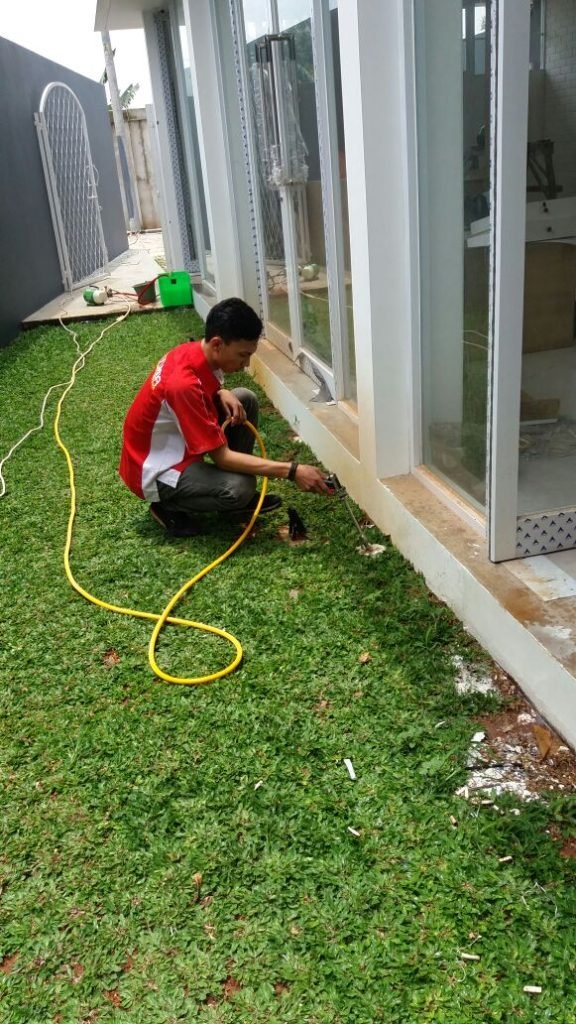
Jakarta exterminators scrape daily mud tubes from the walls of the foundation and call it termite management. It's not. It is not. Mud tubes aren't enemies. They are evidence. Termites don't dig up these channels in the sense that they're interested in building. They build them as their bodies are bags of water encased in thin cuticles that can desiccate in a matter of minutes if the humidity is below 70 percent. Every mud tube on the Jakartan wall represents an admission. The mud tube is exactly in the wall where water escapes from the structure, air conditioner condensate or leaking drainpipes. Capillary rises up in porous brick. The colony could re-establish next to you if you apply anti-termite treatments that contaminate the tube but do not address the moisture issue.
1. Mud Tubes Are Hygrometers, Not Highways
Termites leave soil particles on the areas in which evaporation rates are the highest. A tube erupting from the wall's exterior indicates vapor is escaping that particular mortar joint. The soil beneath a slab is not completely saturated when a tube emerges from the edges. If exterminators use tubes to read water tables instead of invasion routes, they are consultants to improve the performance of buildings rather than pest control agents. This is a more valuable job. It is more valuable work.
2. Twelve Percent is the threshold for Invisibility
At a moisture content of less than 12 percent, wood is biologically invisible to termites that are foraging. Above fifteen percent, it emits detectable volatile compounds. The majority of houses in Jakarta have wood that has never dried out and has crossed the threshold many years ago. Anti-termite firms that don't employ moisture meters or pin-types to test every door frame or window sill as well embedded beams are merely guessing. The clients will be charged for certainty.
3. The 300-500mm Moisture Belt
The soil surrounding the foundation walls is much drier due to roof eaves. Termite feeding activity occurs in the area that is located 300 to 500 millimeters (or less) from the structure. The distance is just right for termites to gain access to the foundation but not allowing them to get soaked by rain. Hydrological deserts have bait stations placed close to the wall. Professional installation involves measuring the gradient and locating stations that attract termites.
4. Potting Mix is Bait Station Technology
A high-organic-load potting mix that is saturated with water and backfilled around bait stations creates a moisture shadow, which extends the lure beyond the station itself. Jakarta's compacted and hardened clay is lacking in the organic matter termites need. Exterminators install stations in unaltered native soil, but they're not traps. The hole should be larger than normal. Imported soil must be used. The moisture needs to be artificially elevated.
5. Above-Ground stations make use of tube behavior
Above-ground stations are tied directly to active mud tubes making termites suffer on their daily trek between feeding site and nest to travel through toxicant-impregnated matrix. This is not baiting; it's toll collection. The tube remains intact, termites continue traveling, and each passing forager brings poison back to the colony nucleus. Exterminators who demolish tubes and stations prior to installing them eliminate their own delivery infrastructure.
6. Water is an Attractant and is not a repellant
US patent 6023879 issued in 2000 describes the method of delivering water to bait stations in such a way that the soil's moisture is higher than in other regions. This makes termites more attracted to the poison. Twenty-five years later, Jakarta exterminators still hold that moisture repels the termites. But it's not. It's not. Pest control companies who don't irrigate their bait arrays are waiting for termites to arrive randomly rather than planning their presence.
7. Lawns are termite Deserts
Chemical fertilizers and pesticides on turfgrass reduces termite activity. Mulched, irrigation-rich, organically-rich planting beds in landscapes sustain termite pressure. Anti-termite programs that spread monitoring stations across all properties regardless of the level of soil cover, are ineffective and waste stations on turf that is sterile while they are not adequately sampling high-risk areas. The stations' grids must be positioned in areas where termites are prevalent.
8. Self-Recruitment can increase the effectiveness
Transferring live termites to an unlit cartridge from a station infested with termites causes self-recruitment behavior. The termites that are introduced to the station's environment are immediately feeding, and then recruit nestmates through trophallaxis. This one-step procedure increases the amount of toxicants used by about 30%. Jakarta exterminators that kill termites that they remove from monitoring stations are not utilizing their effectiveness.
9. Concrete Coring Is Non-Negotiable
Sealed hardscape--driveways, patios, sidewalks--prevents rainfall infiltration and creates artificial dry zones beneath the building perimeter. Professional protocols involve core drilling into concrete to set up bait stations within the soil. The cap made of stainless steel is then fitted flush with the finished grade. In avoiding coring due resistance from homeowners, anti-termite service companies accept that as much as 50% of the perimeter is left untreated. Note this limitation. Document this restriction.
10. Scraping tubes is cosmetic maintenance
Pest control companies offer homeowners the impression that visible tubes of mud are the source of the problem. Their elimination is addressed. This is not the case. The same thing as emptying out a mousetrap before sealing a hole in the baseboard. It's scraping the tubes but not dealing with the moisture that led to their development. Homeowners hire exterminators to eliminate colonies, not to clean the walls. Jakarta anti-termite companies that differentiate between maintenance for cosmetic purposes and colony elimination will dominate this high-end segment.
We also have a conclusion.
Jakarta's fight against moisture as well as mud tube is not an attack on termites. It's a battle against physical science. The soil's chemistry, drainage issues, and construction defects are all expressed by termites. Anti-termite services that position themselves as building performance consultants--arriving with moisture meters, core drills, irrigation tubing, and soil amendments--will win heritage contracts, high-value residential clients, and commercial property portfolios. The only method to compete is through price. Companies that scrape the tubes and sell poison like the calendar was dated 1995 are going to continue competing on price. The gradients of moisture are quantifiable. The irrigation procedure is protected by patents and is twenty-five years old. Jakarta exterminators aren't required to pick between these methods. It's about taking them up before or after their competitors. Check out the top jasa basmi rayap for more advice including jasa anti rayap tangerang, rumah rayap, bahan lemari anti rayap, jasa anti rayap, rayap kecil, anti rayap terbaik, jasa basmi hama, harga anti rayap, anti rayap terbaik, rayap lemari and more.
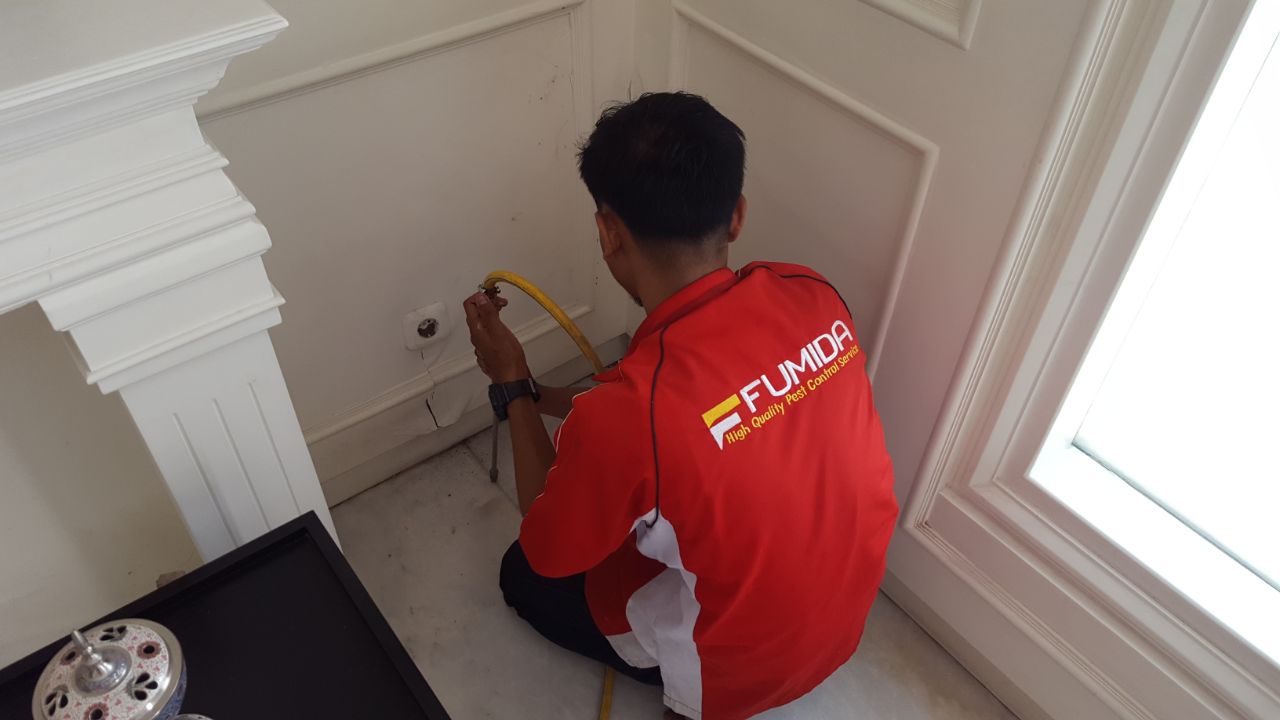
Coptotermes Gestroi - Jakarta Extermination Guide To Termites
Coptotermes is one of the most destructive termite species in Jakarta yet it's the least understood. In imported pest control literature, Coptotermes is described as an underground species that needs constant soil contact. However, Jakarta exterminators frequently find a colonies of gestroi that are living three stories high above the ground in roof spaces and wall cavities. This isn't a peculiar behaviour. It is a key strategy of the species to survive. Coptotermes gestroi originated within Southeast Asia, where the monsoon weather washes away soil colonies. The species that could construct satellite nests that were above the flood level survived. Those who could not survived. Jakarta's Coptotermes gestroi, which is more than 60 million years old, has the genes. It doesn't need soil. It needs wood, moisture and an exterminator with the understanding that treating the soil while ignoring the aerial colonies will guarantee failure.
1. Coptotermes Gestroi Establishes Autonomous Aerial Colonies
Coptotermes Gestroi constructs nests made of chewed wood and saliva. They keep a constant humidity and hold in moisture. These nests function as independent living support structures. Once established in a roof cavity or void in a wall, the colony does not require any ground contact. Pest control companies who treat soil while disregarding the aerial nest are only managing foraging pressure, not eliminating the infestation.
2. Carton Nest Detection requires Thermal or Acoustic Imaging
Nests of Coptotermes gestoli are hidden in structural cavities. They do not produce the appearance of mud tubes on surfaces. They generate detectable moisture elevation and acoustic emission. The termite management services in Jakarta which cater to the premium residential segment are required to employ thermal imaging cameras, along with acoustic detectors. Visual inspection alone confirms only a fraction of active infestations.
3. Bait Transfer is more effective than Other Subterranean methods
Coptotermes gestroi exhibits exceptionally efficient trophallaxis--mouth-to-mouth food sharing--compared to Microtermes and Macrotermes species. Toxicant introduced to 0.1 percent of the foraging population reaches 90% of colony members within fourteen days. Gestroi have an unusual behaviour that makes them vulnerable to being lured. If exterminators are not achieving satisfactory results using gestroi, they may be using suboptimal baiting matrixes, not maintaining station moisture, or not paying attention to above ground station placement.
4. Gestroi
Stations placed around the perimeter of the nest intercept gestroi while they travel between feeding stations as well as the nest. Above-ground stations locked onto active mud tubes intercept foragers who travel between the nest and the structural feeding sites. If gestroi have nestled in the air and are feeding only on the structure, the perimeter stations will not receive any traffic. Above-ground stations are not optional They are the only intervention pathway.
5. Gestroi Alates Swarm from November through February
Coptotermes gestroi reproduces most often during the first wet season between November and February. Millions are born from colonies that have reached maturity, after which they shed their wings, fly for a short time to find their mates looking in soil cracks and rotting trees or structural gaps. Each mating couple is a possibility for a future colony. The anti-termite companies that don't inform homeowners about the risks associated with the phenomenon of swarming miss an opportunity to convert reactive treatments into preventive agreements.
6. Swarms are not a sign of the presence of a new location for infestation
The colony will be located exactly where the winged termites emerge from the baseboards, light fixtures or window frames. It's not. It is not. The cosmetic treatment is carried out by exterminators who inject and drill swarming areas without tracing back the tunnel network towards the nest.
7. Gestroi Foraging Range Exceeds 100 Meters
Coptotermes gestrii colonies live in foraging territories that are over 100 m away from the nest. One colony can spread across multiple structures, sometimes beyond boundaries of property. There could be underground tunnels connecting neighbouring houses or garden sheds with retaining walls and street trees. Reinfestation will occur in the event that exterminators focus on the area infested and do not consider the landscape reservoir.
8. The most important anchoring factor for colonies is moisture
Coptotermes gestroi picks nesting locations based on moisture availability rather than wood species preference. Leaking roof flashings and condensation in roof areas, as well as the capillary rise in masonry supply the moisture that supports aerial carton nests. The colony is expected to return once the conditions improve. The colony can return when the conditions are improved.
9. Sublethal Exposure to Bait Causes Adversion to Bait
Coptotermes gestroi foragers exposed to sublethal levels of some termiticides develop a learned aversion. They cease feeding on bait matrices containing that active ingredient and recruit nestmates to avoid it. Pesticides that use the same formulation over and over, but failing to replace ageing stations, or applying insufficient dose applications, inadvertently select populations that are resistant to bait.
10. Colony Elimination Confirmation Requires Negative Feeding
Colonies of Coptotermes gestroi which have been eradicated leave behind desiccated mud tube and nests of cartons that have been abandoned, and no activity of feeding on monitoring stations. Exterminators that declare colony eradication without monitoring post-treatment for the next 90 days have certify that they are not present due to incomplete data. The certificates expose homeowners who accept them to the danger of a colony recovery that is not detected.
We also have a conclusion.
Coptotermes gestroi is the most powerful urban pest not because it's invulnerable, but because its biology is systematically misunderstood. The species doesn't require soil contact. It constructs independent aerial habitats. It conceals its nest in structural voids, and doesn't reveal the location of its nest via visible evidence on the surface. It doesn't respond well to perimeter baiting. Above-ground stations are needed on feeding sites. It is not able to re-infest in a random manner however, it follows the water gradients. Exterminators often fail to address this. Jakarta antitermite firms that consistently remove gestroi possess five main characteristics. They use thermal-acoustic detection techniques, distinguish soil-based and aerial populations they also prioritize the aboveground station's placement and don't limit their efforts to perimeter programs. Pest control companies with these capabilities are highly sought-after by homeowners who have gestroi infestations. The first offer premium pricing as well as long-term client retention. The latter are competitive in churn and price annually. The Coptotermes Gestroi guideline for elimination Jakarta is not kept secret. The research published by Indonesian Entomologists as well as the commercial performance of specialist baiting companies and the rate of reinfestation for generalist pest-control franchises all confirm the existence of this guide. The issue is not whether this guide exists. Which Jakarta exterminators have it in their books and rely on protocols calibrated by termites who do not live in Jakarta? Check out the best anti rayap jakarta for website info including bahan lemari anti rayap, pest control harga, rayap pekerja, cara membasmi rayap di lemari kayu, cara membasmi rayap di lemari, jasa anti rayap tangerang, pest control harga, rayap lemari, pest control jakarta selatan, cara membasmi rayap di lemari and more.